Speed Reading Research Papers: How to Boost Efficiency & Test Your WPM
February 20, 2026 | By Liam Spencer
The volume of scientific literature published today is staggering. For researchers, staying updated is a full-time job in itself. Over 2.5 million research papers publish annually. This deluge makes staying current feel impossible. You likely have a "to-read" pile that grows faster than you can manage. This information overload leads to burnout and the constant fear of missing a critical breakthrough.
How can you manage thousands of pages of technical data without losing focus? The answer lies in transforming how you approach academic text. Most people read research papers the same way they read a novel—from start to finish. However, academic reading requires a strategic system. Master filtering, skimming, and deep-reading. You'll retain critical insights—and slash reading time by 50%.
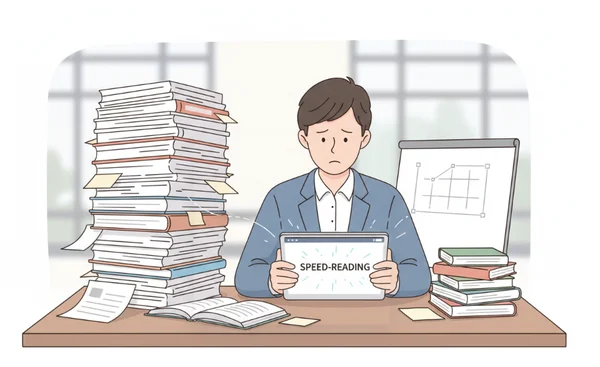
Before you dive into new techniques, it is essential to know where you stand. Measure your baseline with a standardized reading speed test to track progress. This provides a clear starting point. It helps you monitor your improvement as you apply the strategies in this guide to your daily workflow.
Research Paper Speed Reading Fundamentals
Traditional reading habits often fail when applied to dense, technical documents. To master research paper speed reading, you must first understand the unique nature of scientific writing. Unlike fiction, research papers are structured to be predictable. They follow specific formats. This allows a trained eye to find information quickly without reading every single word.
Measure Your Academic WPM for Targeted Improvement
Your reading speed for a news article is likely much higher than your speed for a peer-reviewed study. This is normal. Academic texts are packed with jargon, complex formulas, and nuanced arguments. To improve, you must first define your "academic WPM" (words per minute). Knowing your current reading pace allows you to set realistic goals.
Most adults read at about 200 to 250 WPM. For technical research, this often drops to 100 or 150 WPM. By identifying this starting point, you can estimate the time a specific stack of papers will take. This data-driven approach removes anxiety. It replaces an endless to-do list with a manageable schedule. Benchmark your scientific reading speed here to see how you compare to other academics.
Scientific Approach to Increasing Processing Speed
Increasing your speed is not about moving your eyes faster. It is about how your brain processes information. One common barrier is "subvocalization." This is the habit of saying words in your head as you read. While this helps with complex ideas, it limits your speed to your speaking rate.
To increase your processing speed, you can practice "chunking." This involves looking at groups of words rather than individual letters. In a scientific context, your brain can recognize common phrases like "statistically significant" as a single visual unit. This reduces cognitive load. It allows for a smoother flow of information. You can take a research-focused speed test to see if chunking improves your results.
Balancing Speed and Comprehension in Scientific Contexts
Speed is useless if you do not understand the methodology or results. In science, accuracy is everything. Effective research paper speed reading is actually about "variable rate reading." This means you move quickly through familiar sections. You then slow down for the "Methods" or "Results" where the core data resides.
The goal is not to read 1,000 WPM across the entire paper. Instead, spend 80% of your time on the 20% of the paper with the most value. This balance ensures you remain an expert while being the most efficient person in the lab. Use a regular reading speed test to ensure your comprehension stays high as your WPM increases.
Academic Literature Review Strategies for Large Volumes
When faced with a massive literature review, you need a system to triage papers. Not every paper deserves two hours of your time. Using structured academic literature review strategies helps you decide which papers to study and which to discard.
Three-Tier Literature Screening System
A structured screening system prevents you from wasting hours on irrelevant studies. You can use this three-tier approach to manage your library:
-
The Five-Minute Scan: Read the title, abstract, and conclusion. If the paper doesn't align with your project, stop here.
-
The Skim (15 Minutes): Look at the headings, figures, and tables. Read the first and last sentence of each paragraph in the Introduction.
-
The Deep Dive: If the paper is vital, read it thoroughly. Focus on the methodology and data analysis.
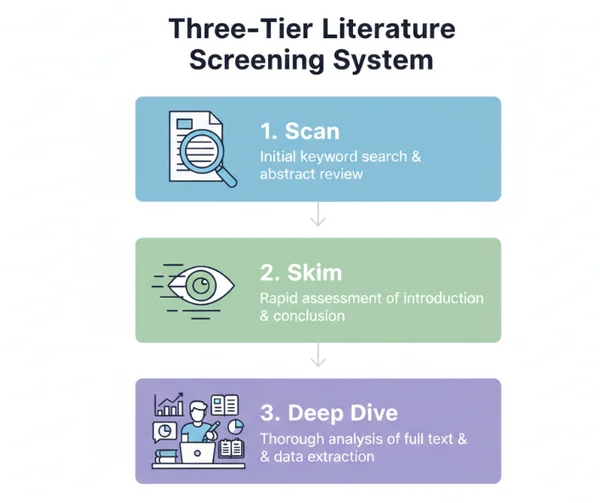
By using this system, you can process twenty papers in the time it used to take to read two. To see how much time this saves you, test how tiered screening affects your WPM and compare your speed across different levels of technical difficulty.
Skimming Techniques for Scientific Abstracts and Introductions
The Abstract and Introduction are designed to give you the "big picture." When skimming these sections, look for the "problem statement" and the "gap." Researchers usually signal these with words like "however" or "remains unclear."
Once you find the gap, look for the author's hypothesis or main contribution. This is usually found at the very end of the Introduction. If you understand the problem and the proposed solution, you have captured 50% of the paper's value. You can check your WPM during skimming to see if your scanning speed is improving.
Deep Reading Methods for Methodology and Results Sections
When you move to the Methodology and Results, you must slow down. These sections are the backbone of the study. Look for the sample size, the control variables, and the p-values. If you are doing a meta-analysis, these are the only sections that truly matter.
A great deep-reading tip is to explain the methodology to yourself in simple terms. If you cannot summarize a complex experiment in two sentences, you haven't understood it yet. This active engagement keeps your comprehension high. It helps you improve your comprehension-based reading rate even when the text is difficult.
Scientific Skimming Techniques That Preserve Accuracy
Skimming is often misunderstood as "skipping." In reality, scientific skimming techniques are about highly focused attention. You are looking for patterns and specific data points rather than reading every adjective.
Visual Pattern Recognition in Research Papers
Most research papers follow the IMRAD structure: Introduction, Methods, Results, and Discussion. Your brain can use this pattern to navigate. If you need to know how they gathered data, your eyes should jump to the middle of the document. If you want to know the "so what," jump to the Discussion. Recognizing these patterns allows you to navigate a 20-page document like a single-page map.
Keyword-Based Section Navigation
Academic writers use specific "signpost" words to guide readers. By training your eyes to catch these keywords, you can skip the filler.
- Contrast words: "Conversely," "On the other hand," "Nevertheless."
- Result words: "Consequently," "Therefore," "Our data suggests."
- Emphasis words: "Crucially," "Of particular interest," "Notably."
Focusing on these words helps you identify when the author is making a major point. It is a powerful way to analyze your skimming efficiency while ensuring you don't miss the logical flow of the argument.
Figure and Table First Approach
Figures and tables often hold a study's key insights. A well-designed graph can summarize years of research in seconds. Prioritize visuals—they're efficiency goldmines. Before reading the text of the Results section, look at the charts. Read the captions carefully. If you can interpret the data yourself, you will be less biased by the author's interpretation. This "Visual First" approach is a hallmark of highly efficient researchers.
AI-Assisted Screening for Research Literature
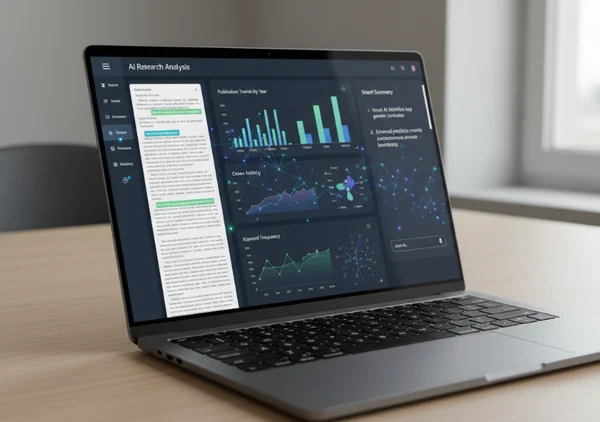
Technology can be a powerful ally in managing the academic flood. While AI should never replace critical thinking, it can certainly help with search efficiency and organization.
Setting Up Automated Filters for Relevant Studies
Stop manually searching for papers every morning. Use tools like Google Scholar Alerts to set up automated filters. Use specific Boolean strings to ensure only the most relevant papers land in your inbox. This automates the first tier of your screening system. It saves you hours of manual searching every week.
Using Citation Networks to Identify Influential Research
Efficiency is about reading the right papers, not just reading papers fast. Use citation mapping tools to see which papers are the "hubs" of a specific topic. If a paper has been cited 500 times in two years, it is likely a foundational text. Conversely, if a paper has no citations and is five years old, you can likely skip it.
AI Summarization Tools: When and How to Use Them
New AI tools can summarize long papers into bullet points. Use these for your "Tier 1" screening. However, be careful. AI can sometimes miss subtle nuances in the data. Use AI to decide if you should read a paper, but never let it be the final word. For high-stakes research, there is no substitute for your own trained eyes. You can try a reading speed test before and after AI help to see how it impacts your processing time.
Ready to Conquer Your Research Backlog?
Start by measuring your academic WPM, then apply the tiered screening method we've outlined. Think of your reading system as a lab experiment—test, refine, and track what works. Thousands of researchers already use our reading speed test to benchmark their progress. Where will you rank? Don't let your "to-read" pile hold you back any longer. The first step to mastering your literature review is knowing your current capabilities. Visit our homepage to take the test and start your journey toward academic efficiency today!
FAQ Section
What is a good reading speed for academic papers?
For technical and academic literature, a "good" speed is typically between 100 and 200 WPM with high comprehension. Because the content is dense, it is natural to read slower than you would a novel. The key is to maintain understanding. You can find your specific academic rate by using our free reading speed test.
How can I improve my reading speed for scientific literature?
The best way to improve is through "active reading" and practice. Use a pointer to guide your eyes and prevent "regression." This is when your eyes skip backward. Additionally, learning the common structures of papers in your field will help you navigate faster. Consistent practice and regular testing will show you which techniques work best for your brain.
Does reading on a screen slow down comprehension of research papers?
Some studies suggest that reading on a screen can be slightly slower than reading on paper due to eye strain. However, digital tools allow for better searching and highlighting. To mitigate the speed loss, use a high-resolution screen. Adjust the brightness and use "Reading Mode" in your browser to remove distractions.
What is the average WPM for processing academic literature?
While the average adult reads general text at 240 WPM, the average for academic processing is often around 120-150 WPM. This is because research requires critical thinking and data verification. Don't be discouraged by a lower number. In the world of science, "effective reading speed" is the metric that truly matters. You can test your WPM now to see where you fall on the average scale.