Bilingual Reading Speed Test: Boost Your WPM Across Multiple Languages
December 25, 2025 | By Liam Spencer
Have you ever noticed that you read faster in your native language than in a second one? Or perhaps you're a polyglot who feels your reading pace changes dramatically depending on whether you're reading Spanish, English, or Japanese? This isn't just your imagination; it's a common experience for multilingual individuals. The silent challenge is maintaining both speed and comprehension as you switch between languages.
Fortunately, you can train your brain to become a more efficient reader across all the languages you know. This guide explores the science behind why reading speeds differ and provides practical strategies to boost your words per minute (WPM) without sacrificing understanding. To see where you stand right now, you can always take a free test and get an instant benchmark.

Understanding Language-Specific Reading Speed Variations
Before you can improve, it helps to understand why you might read at 300 WPM in English but only 180 WPM in German. The reasons are rooted in linguistics and cognitive science. Recognizing these differences is the first step toward developing effective bilingual reading strategies.
Why Some Languages Naturally Read Faster Than Others
Not all languages are created equal when it comes to information density. Researchers have found that some languages, like Spanish or Japanese, have a lower information density per syllable. This means you need more syllables—and more time—to express the same idea that a "denser" language like English or Mandarin Chinese conveys more concisely.
As a result, speakers of less dense languages often speak and read faster to compensate. This is why comparing your raw WPM score in Spanish directly to an English score can be misleading. It’s not just about how fast your eyes move, but how quickly your brain processes the information unique to that language's structure.
The Science Behind Code-Switching Fatigue
If you regularly switch between languages—say, reading an English report for work and then a French novel for pleasure—you might experience something called "code-switching fatigue." Code-switching is the cognitive process of shifting between two or more languages. While it's a powerful skill, it demands mental energy.

Each time you switch, your brain has to inhibit one linguistic system and activate another. This includes different grammar rules, vocabulary, and even sound systems. This mental gear-shifting can temporarily slow your reading speed and even affect comprehension until your brain fully settles into the new language. Understanding this helps you be more patient with yourself and use strategies to ease the transition.
Language-Specific Optimization Strategies
Improving your multilingual reading speed isn't a one-size-fits-all process. The best approach depends on the structure of the languages you're reading. By tailoring your techniques, you can overcome specific hurdles and unlock greater efficiency.
Mastering Syllabic vs. Alphabetic Reading Systems
Languages can be broadly categorized by their writing systems. English is an alphabetic language, where letters represent sounds. In contrast, languages like Spanish or Italian are highly syllabic, with a very consistent link between letter groups and sounds.
For alphabetic languages like English, a key skill is recognizing whole words and phrases rather than sounding out letters. For syllabic languages, you can train your brain to recognize common syllables as single units. This chunking method, whether by word or syllable, helps you move beyond one-sound-at-a-time reading and significantly boosts your pace.
Strategies for Logographic Languages (Chinese, Japanese)
Logographic languages, such as Mandarin Chinese and Japanese (which uses Kanji), present a unique challenge. Each character represents a word or concept, not just a sound. This requires a different kind of visual processing.

To read these languages faster, focus on improving character recognition speed. Use flashcards or apps to drill high-frequency characters until you recognize them instantly. Also, practice recognizing common two- or three-character compounds as a single "chunk" of meaning. This is similar to word-grouping in English but requires a character-based approach.
Optimizing for Agglutinative Languages (German, Finnish)
Agglutinative languages like German, Finnish, or Turkish are known for their long, complex words. These languages "glue" prefixes, suffixes, and roots together to form a single word that might take a full sentence to express in English.
For example, a long German word can often be intimidating and slow a reader down. The key is to train your eye to quickly deconstruct these words. Learn to spot the core root word first, then interpret the affixes that modify its meaning. With practice, you can process these compound words much faster instead of getting stuck on them.
Measuring and Tracking Your Multilingual Reading Progress
You can't improve what you don't measure. To truly master bilingual speed reading, you need a reliable way to assess your skills and track your growth in each language. This is where a dedicated tool becomes essential.
Creating a Baseline: Your First Multilingual Reading Assessment
Your first step is to establish a baseline. What is your current WPM and comprehension score in each of your languages? Without this starting point, it's impossible to know if your new strategies are working.
Take a few minutes to measure your performance in each language you want to improve. This initial assessment gives you the data you need to set realistic goals. You can start your test on our platform, which supports a wide variety of languages for this very purpose.
Interpreting Results: Language-Specific Benchmarks
Once you have your scores, it's crucial to interpret them in the right context. As we've discussed, a "good" WPM in English is different from a "good" WPM in Japanese. Don't be discouraged if your scores vary significantly between languages.
Instead, use your results to understand your personal strengths and weaknesses. Perhaps your speed is high in German, but your comprehension is low. Or maybe your reading in French is slow but highly accurate. These insights tell you exactly what to focus on in your training. To understand where you stand, a quality reading pace calculator can provide helpful context.
Tracking Cross-Language Improvement Over Time
Improvement requires consistency. Make it a habit to re-test your reading speed and comprehension in each language every few weeks. This allows you to see tangible evidence of your progress.
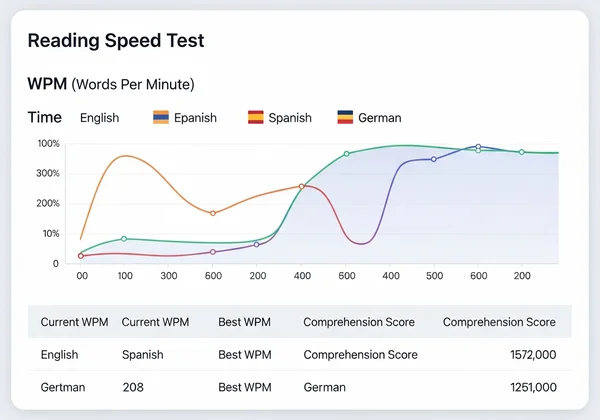
Are your new strategies for reading Chinese characters paying off? Has your WPM in Spanish increased after practicing syllabic chunking? Tracking your data over time provides motivation and helps you refine your approach. A consistent log of your scores is the best way to see your journey toward multilingual reading mastery unfold.
Your Journey to Multilingual Reading Mastery
Becoming an efficient multilingual reader is a journey of understanding, strategy, and consistent practice. It starts with recognizing that different languages demand different approaches. By tailoring your techniques to alphabetic, syllabic, or logographic systems, you can overcome specific hurdles and read more effectively.
As you work on your multilingual reading skills, keep these insights in mind:
- Context Matters: Reading speeds naturally vary between languages due to information density. When comparing your WPM scores across languages, consider the unique characteristics of each.
- Tailor Your Approach: Different languages require different techniques. For English, practice chunking words; for Spanish, focus on syllable recognition; and for German, work on deconstructing compound words.
- Track Your Progress: Improvement requires consistent measurement. Regularly track your WPM and comprehension scores in each language to see tangible results of your efforts.
Are you ready to discover your true reading potential across languages? The next step is to get your baseline. Start your free reading speed test now and unlock a more efficient way to navigate our multilingual world.
FAQ Section
What is a good reading speed for bilingual readers?
A "good" reading speed for a bilingual reader varies greatly depending on the language and their proficiency in it. Generally, an average adult's reading speed in their native English is around 200-300 WPM with good comprehension. In a second language, a proficient reader might aim for 150-250 WPM. The ultimate goal is to maintain at least 80% comprehension, regardless of speed.
How can I maintain comprehension when reading faster in my second language?
To maintain comprehension, avoid passive reading. Engage with the text by asking questions, highlighting key ideas, and briefly summarizing paragraphs in your mind. Also, focus on expanding your vocabulary in that language. The more words you know instantly, the less mental energy you spend on decoding, freeing up your brain to focus on meaning.
Does learning a new language affect my reading speed in my native language?
For most people, learning a new language does not negatively affect their native reading speed. In some cases, it can even improve it. Learning another language enhances your metalinguistic awareness—your understanding of how language works—which can make you a more conscious and skilled reader in your native tongue.
How often should I test my reading speed in different languages?
To track progress effectively, it's a good idea to test your reading speed every 2 to 4 weeks. This frequency is enough to see measurable improvements from your practice without causing stress. The key is consistency. You can always check your progress anytime to see how your skills are developing.