How to Read a Book Fast and Still Understand It
June 13, 2026 | By Liam Spencer
Learning how to read a book fast is not the same as forcing your eyes across every page at maximum speed. The better goal is to finish the book with the right level of understanding for your purpose. A textbook chapter, a business book, a novel, and a research-heavy nonfiction title do not deserve the same reading strategy. Before you try to move faster, use a quick reading speed baseline to see how your current pace and comprehension work together. Then choose a method that helps you spend less time on low-value pages and more attention on the ideas that actually matter.

Start With the Reason You Need the Book
Fast reading begins before page one. Ask one practical question: what do I need this book to do for me? If you need to pass a quiz, you need key terms, arguments, examples, and likely testable details. If you need to discuss the book in class, you need the thesis, structure, evidence, and a few strong passages. If you are reading for work, you may need decisions, frameworks, warnings, or examples you can apply.
This purpose sets your reading gear. Some pages deserve close reading. Some deserve a quick skim. Some can be skipped after you confirm they do not serve your goal. That is not laziness; it is attention management. A reader who tries to absorb every caption, anecdote, and footnote at the same depth often finishes slower and remembers less because every sentence seems equally important.
Write your purpose in one sentence before you begin. For example: "I need the main argument and three usable examples by Friday." That sentence becomes your filter when the book starts to feel large, slow, or boring.
Preview the Book Before You Read Page One
The fastest readers rarely enter a book cold. They preview first, because a map reduces wasted effort. Spend 10 to 20 minutes scanning the title page, subtitle, back cover, table of contents, introduction, conclusion, chapter titles, section headings, summaries, diagrams, and index. For a school or work book, also check assignment questions, lecture themes, or the reason the book was assigned.
Your goal is not to understand everything yet. Your goal is to predict the book's architecture. What problem is it trying to solve? Which chapters look central? Which chapters look like background, examples, or optional depth? Where does the author define terms? Where do they answer objections?
Use a simple preview note:
- Main question of the book:
- Likely core chapters:
- Sections I can skim:
- Terms or names to watch:
- What I need to remember:
This is especially useful when you need to read a big book fast. A 300-page book feels less intimidating when you know that 80 pages are setup, 120 pages carry the main argument, and the rest are examples, context, or reference material.
Set a Page-Time Budget Instead of Chasing a Mythical WPM
Searches like "can you read 200 pages in 4 hours" or "how quickly can I read a 300 page book" usually hide a better question: how much understanding do I need from these pages? Page counts are slippery. A page of a novel may contain far fewer words than a dense academic page. Fonts, margins, footnotes, images, and technical vocabulary all change the real workload.
A more useful estimate is:
- Count the words on a typical page, or estimate 250 to 350 words for many standard books.
- Multiply by the number of pages you need to cover.
- Divide by your comfortable WPM, not your dream WPM.
- Add time for notes, breaks, and review.
If a book averages 300 words per page, 100 pages is about 30,000 words. At 250 WPM, the raw reading time is about two hours, before notes and pauses. That can be fast for careful study and normal for lighter reading. A 200-page book at the same density is about 60,000 words, which could take four hours at 250 WPM if the material is familiar and you are not annotating heavily. A 300-page book may take six hours or much longer depending on difficulty.
The best move is to measure your current WPM and comprehension, then build a realistic budget. If comprehension drops sharply when you speed up, the plan needs adjustment, not self-criticism.
Use a Three-Pass Method for Fast Reading
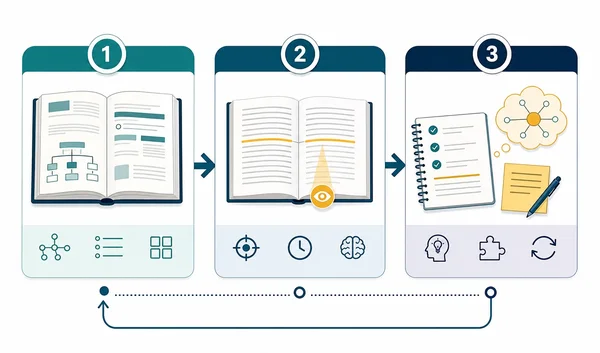
The three-pass method is a practical way to read faster and retain more. It keeps you from treating every page as a first-time mystery.
Pass 1: Map the Book Quickly
Read the introduction, conclusion, table of contents, chapter openings, chapter endings, headings, and any summaries. Skim examples and stories. Mark only the sections that look essential. This pass should be quick and imperfect. You are building orientation, not mastery.
For school reading, compare your map with the syllabus, lecture notes, or study questions. For work reading, compare it with the decision or project you need to support. For personal reading, ask which chapters actually match the reason you picked up the book.
Pass 2: Read the Core Sections Actively
Now read the most important chapters or sections with focus. Use a finger, pen, cursor, or reading ruler to reduce drifting and keep your eyes moving. Do not underline entire paragraphs. Instead, mark claims, definitions, contrast words, lists, examples that prove the point, and sentences that answer your original purpose.
If a paragraph seems minor, read the first and last sentence, then skim the middle. If it seems central, slow down. Fast reading is flexible reading. The win is not moving at one speed; the win is matching speed to value.
Pass 3: Fill Gaps and Lock In Memory
After the core read, close the book and write a five-line recall note:
- What is the book mainly arguing?
- What are the three most important ideas?
- What evidence or examples support them?
- What was unclear?
- What will I do with this information?
Then return only to the unclear or high-value sections. This final pass is where retention improves. You are not rereading everything. You are repairing gaps while the book is still fresh.
Read Faster in Your Head Without Fighting Your Brain
Many readers slow down because they silently pronounce every word, reread lines automatically, or let their eyes wander. These habits are common. They are not personal failures, and they do not require extreme speed-reading claims to improve.
Try three gentle adjustments:
- Use a guide. Move a finger, pen, or cursor just under the line. A guide can reduce regressions and help your eyes keep a steadier rhythm.
- Group words. Instead of aiming at every word, let your eyes land on short phrases. This is easier with familiar material and harder with technical prose.
- Reduce unnecessary rereading. If you missed a word but still understand the sentence, keep going. If you missed the argument, stop and reread deliberately.
Do not try to eliminate your inner voice completely. Some subvocalization helps comprehension, especially in difficult text, second-language reading, poetry, dialogue, and unfamiliar terms. The goal is to loosen the habit when it is slowing down easy material, not to fight your brain on every line.
If ADHD or another attention-related condition affects your reading, treat these tips as general study strategies rather than personal medical guidance. Smaller sessions, visible timers, page targets, movement breaks, and reduced distractions may help, but a qualified professional can give support that fits your situation.
Use Kindle, AI, and Digital Tools Without Outsourcing Judgment
Digital tools can help you read books faster, but they work best as support. On Kindle or another e-reader, use font size, line spacing, highlights, search, and notes to reduce friction. A larger font can make line tracking easier for some readers. Search can help you revisit a term without flipping through the whole book. Highlights can become a review list if you keep them selective.
AI tools can speed up preparation and review. You might ask for a neutral chapter summary, a list of key terms, or questions to check your understanding. But do not let AI replace your reading when the assignment, decision, or conversation depends on your own understanding. Summaries can miss nuance, flatten disagreement, or make uncertain points sound cleaner than they are.
A useful AI workflow is:
- Preview the chapter yourself.
- Ask for a short list of concepts to watch for.
- Read the chapter.
- Write your own summary.
- Use AI questions to test what you may have missed.
That keeps the thinking with you while still reducing setup time.
Keep Retention High While You Move Fast
The fastest way through a book is not always the fastest way to remember it. If you need retention, build small review moments into the reading session.
Use margin codes instead of long notes:
Tfor thesisDfor definitionEfor evidence?for confusionAfor application
After each chapter, pause for two minutes and write a one-sentence summary from memory. After every 45 to 60 minutes, take a short break and review only your marked T, D, and ? notes. At the end, create a one-page book brief with the main argument, chapter map, five key ideas, and two questions you would ask the author.
This matters because reading faster and retaining more is usually about retrieval, not highlighting. When you ask your memory to produce the idea, you find out whether you understood it. When you only recognize a sentence on the page, it can feel familiar without being usable.
Know When to Slow Down
A fast method should include permission to slow down. Read more carefully when the book contains formulas, legal or financial consequences, medical information, dense theory, unfamiliar English, complex instructions, or passages you need to quote accurately. You may also slow down for literary style, emotional scenes, or books you want to enjoy rather than complete.
For English learners, speed grows with vocabulary, grammar familiarity, and topic knowledge. Skimming can help you find structure, but unfamiliar words may require slower reading and spaced review. For beginners, the first goal is not a heroic pace. It is a repeatable process: preview, read the most important sections, recall, and return to gaps.
The same applies to boring books. If a book is dull but required, do not rely on willpower alone. Shorten the task. Read in 20-minute blocks, set a page range, keep a visible question beside you, and reward completion of sections rather than waiting for motivation to appear.
Build Your Next Fast-Reading Session
Here is a simple session you can use the next time you need to finish a book quickly:
- Write your purpose in one sentence.
- Preview the book for 10 to 20 minutes.
- Estimate your page-time budget.
- Map the chapters and choose priority sections.
- Read core sections with a guide and selective notes.
- Pause after each chapter for a memory summary.
- Revisit only gaps, key passages, and confusing sections.
- Finish with a one-page book brief.
If you want a practical starting point, review your own reading baseline before the session and again after a few weeks of practice. The goal is not to prove that you can read a book super fast once. The goal is to build a repeatable way to read a book fast enough for your deadline while still understanding what you came for.
FAQ
Is reading 100 pages in 2 hours fast?
It can be fast, normal, or slow depending on the book. If the pages average about 300 words, 100 pages is roughly 30,000 words. Reading that in two hours is about 250 WPM before breaks and notes. That is reasonable for familiar or lighter material, but demanding for dense study.
How do I speed up reading a book?
Start with a purpose, preview the structure, estimate the workload, and read in passes. Use skimming for orientation, active reading for key sections, and short recall notes for memory. A guide such as a finger, pen, or cursor can also reduce drifting and unnecessary rereading.
Can you read 200 pages in 4 hours?
Yes, sometimes. If the book is not too dense and the page layout is average, 200 pages in four hours may be possible at about 250 WPM. Add more time if you need annotations, careful comprehension, unfamiliar vocabulary, or detailed recall.
How quickly can I read a 300 page book?
A 300-page book might take six to ten hours for many readers, but the range is wide. Light fiction may be faster. Dense academic nonfiction may take much longer. Estimate words per page, divide by your comfortable WPM, and add review time.
How can I read a book fast for school?
Use the assignment as your filter. Preview the book, compare chapters with the syllabus or study questions, read introductions and conclusions carefully, and focus on sections that support likely discussion, quiz, or essay points. Keep brief recall notes after each chapter.
How do I read faster and retain more?
Retention improves when you retrieve ideas, not just when you highlight them. After each chapter, close the book and write the main point from memory. Then revisit only the parts that were unclear, important, or likely to matter later.
Can AI help me read books faster?
AI can help with preparation and review, such as listing key terms or asking comprehension questions. It should not replace your own reading when accuracy, judgment, or discussion matters. Read first, summarize in your own words, then use AI to check gaps.
How can I read faster in English?
Build vocabulary and topic familiarity, preview before reading, and use phrase groups instead of word-by-word reading when the text is familiar. Slow down for new terms, idioms, or complex arguments. Speed in a second language grows best when comprehension stays in the plan.