Reading Speed and Comprehension: The Ultimate Guide to Balanced Reading Efficiency
January 26, 2026 | By Liam Spencer
Have you ever finished reading a page, only to realize you don't remember a single thing? Many of us chase higher reading speeds, believing that faster is always better. But what good is speed if you lose understanding along the way? The real goal isn't just to read faster, but to read smarter. This is the art of balancing your reading speed with comprehension.
This guide will show you how to find your perfect reading rhythm. We will explore the science behind reading efficiency, share practical strategies for different types of texts, and explain how to measure what truly matters. To get started, it's helpful to know your current baseline. You can discover your words per minute (WPM) and comprehension score with a free reading test.
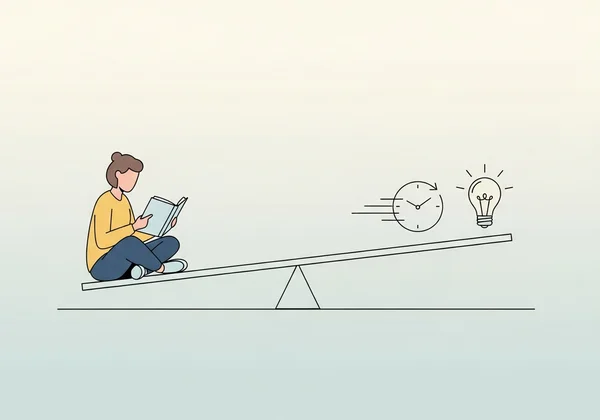
Understanding Reading Speed and Comprehension Trade-Offs
Before you can improve your reading speed, you need to understand the fundamental relationship between how fast you read and how much you understand. They are two sides of the same coin. Pushing one too far often comes at the expense of the other. The key is to find a balance that works for you and your reading goals.
The Cognitive Science Behind Reading Efficiency
Reading isn't a passive activity. Your brain is working hard to decode words, connect ideas, and store information. Reading too quickly can cause you to skip important words or miss key connections. Your brain simply doesn't have sufficient time to process the information thoroughly.
Think about it this way: if you speed through a scenic route, you'll reach the end faster, but you'll miss the beautiful views. Effective reading requires giving your brain enough time to "see the sights" on the page. It involves recognizing words, understanding their meaning in context, and linking new information to what you already know. True efficiency is finding the fastest reading speed at which you can still do all of this successfully.

What Research Says About Optimal Reading Speeds
There is no single "best" reading speed. Research shows that comprehension starts to decline significantly once readers push their speed beyond a certain point. For most adults, an average reading speed is around 200-300 WPM for non-technical material. Speeds above 400 WPM often lead to a drop in understanding unless the reader has had specific training.
Your optimal reading speed varies based on the material and your purpose. For example, you'd need to read a complex legal document slowly and deliberately, whereas you can skim a news article quickly to find the main points. The goal is not to hit a magic number but to develop a flexible approach that you can adapt to any situation.
Identifying Your Personal Reading Sweet Spot
Your "sweet spot" is the reading pace where you can maintain high comprehension without feeling like you are crawling through the text. It's the point of maximum efficiency. How do you find it? The first step is to measure your current performance.
A comprehensive test that measures both speed and understanding is essential. After you see your results, you can start experimenting. Try reading slightly faster and see if your comprehension score drops. Then, try slowing down and see if it improves. This process of testing and adjusting will help you pinpoint the WPM range where you perform your best.
Strategic Approaches for Different Reading Materials and Speeds
A great reader is like a driver who knows when to speed up on the highway and when to slow down in a busy city. You shouldn't use the same reading strategy for every book, article, or report. Tailoring your approach and reading speed to the content is crucial for achieving true reading efficiency.
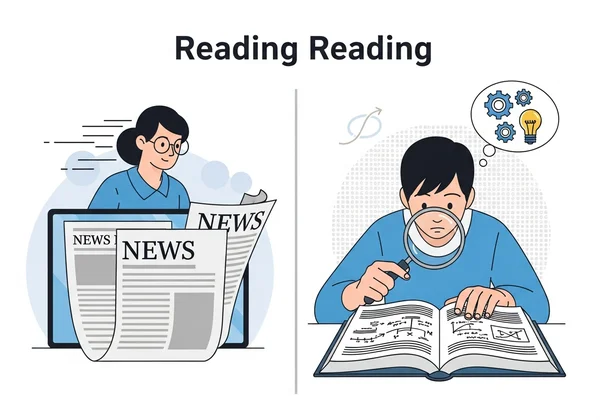
When to Prioritize Speed: Informational vs. Critical Texts
Not all texts are created equal. You need to decide your goal before you begin reading. Are you reading to find a specific fact, get a general overview, or deeply understand a complex argument?
- Prioritize Speed: For informational texts like news articles, blog posts, or emails, your goal is often to grasp the main ideas quickly. In these cases, you can use techniques like skimming and scanning to increase your reading speed. Don't worry about absorbing every detail.
- Prioritize Comprehension: For critical texts like textbooks, research papers, or important contracts, accuracy is paramount. Here, you must slow down to ensure you understand every nuance and implication. Speed is secondary to deep comprehension.
Depth Reading Techniques for Maximum Comprehension
When you need to truly understand and remember what you read, surface-level reading isn't enough. Depth reading techniques help you engage with the material on a more profound level.
One popular method is the SQ3R technique: Survey, Question, Read, Recite, Review.
- Survey: Skim the chapter, looking at headings, images, and summaries to get a general idea of the content.
- Question: Turn headings into questions. This gives your reading a clear purpose.
- Read: Read the section actively, searching for answers to your questions.
- Recite: After each section, pause and summarize the key points in your own words.
- Review: Once you've finished, review your notes and the chapter to solidify your understanding.
Adaptive Strategies for Mixed-Content Documents
Many documents, like business reports or long-form online articles, contain a mix of content. They might have a summary, detailed data sections, and concluding remarks. An adaptive reader changes pace within the same document.
You might skim the introduction to get an overview, read the data analysis section slowly and carefully, and then scan the conclusion for the key takeaways. This flexible approach saves time without sacrificing the comprehension of critical sections. Learning to shift gears like this is a hallmark of an expert reader.
Measuring and Improving Your Reading Speed and Comprehension
You can't improve what you don't measure. If you're serious about becoming a more efficient reader, you need a reliable way to track your progress. This goes beyond just timing yourself; it involves looking at the right metrics and understanding what they mean.
Beyond WPM: The Most Important Metrics to Track
Words Per Minute (WPM) is a useful starting point, but it only tells half the story. To truly improve your reading speed, you must first understand how comprehension and speed interact. The most important metric is actually Effective Reading Rate (ERR), which combines your reading speed with your comprehension score. For example, reading at 400 WPM with only 50% comprehension is less effective than reading at 250 WPM with 90% comprehension.
When you start your test, pay close attention to both numbers. Your goal should be to increase your WPM without letting your comprehension score fall. This is the true measure of reading efficiency.
Creating a Personalized Reading Efficiency Dashboard
To monitor your progress, consider creating a simple log or dashboard. You can use a notebook or a spreadsheet. After each practice session or test, record the following:
- Date:
- Type of Text: (e.g., novel, news, textbook)
- WPM:
- Comprehension Score (%):
- Notes: (How did you feel? Was it difficult? What strategy did you use?)
This simple habit will allow you to see patterns over time. You'll discover which types of material you read best and which reading speed techniques give you the biggest boost in performance.
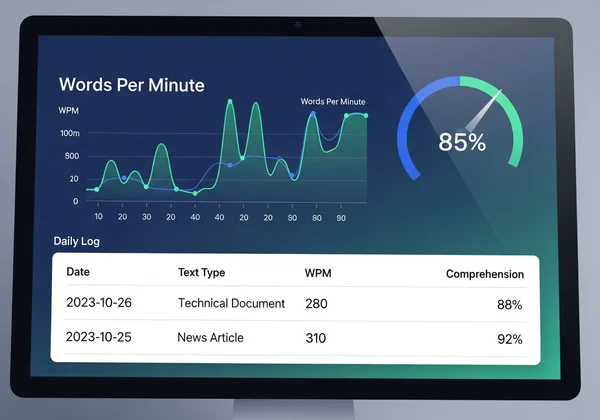
Benchmarking Your Performance Against Standards
Knowing your numbers is great, but context is even better. How does your reading efficiency compare to others? Standard benchmarks can help you set realistic goals for your reading speed.
- Below 150 WPM: Generally considered a slow pace.
- 200-300 WPM: The average for most adults.
- 300-450 WPM: A good, efficient pace.
- Above 450 WPM: An expert-level speed, often requiring specific techniques.
Use these benchmarks as a guide, not a strict rule. Your primary goal is to improve against your own previous scores. You can use a reading pace calculator to see where you stand and track your improvement over time.
Advanced Techniques for Expert-Level Reading Speed
Once you have mastered the basics of balancing speed and comprehension, you can explore advanced techniques to take your skills to the next level. These methods require practice but can lead to significant gains in your ability to process information effectively and improve reading speed.
Metacognitive Reading: Thinking About Your Thinking While Reading
Metacognition involves being aware of your own thinking patterns. When reading, it means actively checking your comprehension as you progress through the text.
Here's a practical approach: ask yourself questions as you read, like "Do I understand this concept?" or "Is my mind wandering?" If you realize you've lost focus or are confused, pause and reread the section. This self-awareness prevents you from "reading" pages on autopilot without absorbing anything. It's a powerful tool for keeping your comprehension high, even at faster speeds.
Environmental Factors That Impact Speed vs. Comprehension
Your reading environment plays a surprisingly large role in your efficiency. To create an optimal setup, pay attention to a few key factors:
- Minimize Distractions: Find a quiet space. Turn off notifications on your phone and computer. Even small interruptions can break your concentration and force you to reread.
- Ensure Good Lighting: Poor lighting can cause eye strain, which slows you down and makes reading feel like a chore.
- Comfortable Posture: Sit upright in a comfortable chair. Slouching can reduce your energy levels and focus.
By controlling your environment, you free up more mental energy to focus exclusively on the text.
Technology Tools to Optimize Your Reading Approach
In the digital age, we have access to incredible tools that can support our reading goals. While a focused mind is your best asset, technology can help. From apps that train you to reduce subvocalization (saying words in your head) to platforms that deliver text in a rapid, focused manner, there are many options to explore.
However, the most fundamental tool is one that gives you accurate feedback. A reliable reading speed and comprehension test is your best partner in this journey. Use it regularly to validate your new skills and identify areas for further improvement. Ready to see how these techniques work for you? Try our free tool.
Your Personalized Strategy for Reading Efficiency
Becoming a more efficient reader is not about chasing an impossibly high WPM. It’s about developing a smart, flexible approach that allows you to read faster while maintaining strong comprehension. The ultimate goal is to read with purpose, adapting your reading speed to the task at hand.
Focus on these essential principles:
- Find Your Balance: True efficiency lies in the sweet spot between reading speed and comprehension.
- Be Strategic: Use different reading speeds and techniques for different types of materials.
- Measure and Monitor: You cannot improve what you do not measure. Regularly track both your WPM and your comprehension score.
Your path to becoming a more efficient reader begins right here: understanding where you are right now. By taking a comprehensive test, you gain the personal insights needed to build a targeted improvement plan for your reading speed.
Ready to uncover your reading potential? Start your Reading Speed Test now and take the first step toward becoming a more powerful and efficient reader today!
Frequently Asked Questions About Speed vs. Comprehension
What is the ideal balance between reading speed and comprehension?
There is no universal "ideal" balance. It depends on your goal. For leisure reading, you might prioritize enjoyment at a comfortable pace. For studying, you might aim for 85-95% comprehension, even if it means reading more slowly. The key is to consciously choose your balance for each reading task.
How can I measure my reading efficiency beyond just WPM?
The best way is to calculate your Effective Reading Rate (ERR) by multiplying your WPM by your comprehension percentage (e.g., 300 WPM x 0.85 comprehension = 255 ERR). A reliable tool like the one on our site does this for you automatically, giving you a much clearer picture of your true efficiency. Find out your ERR by taking a quick and easy test.
Does reading speed affect comprehension differently for various content types?
Absolutely. For simple narrative texts, you can often read faster with minimal loss of comprehension. For dense, technical, or abstract material, even a small increase in reading speed can cause a significant drop in understanding. Expert readers learn to adjust their pace automatically based on the complexity of the text.
Can I improve both speed and comprehension simultaneously?
Yes, but it requires a strategic approach. Instead of just trying to read faster, focus on techniques that improve processing efficiency, such as reducing subvocalization and reading in thought-groups rather than word-by-word. As your brain gets better at processing text, your reading speed will naturally increase without sacrificing comprehension.
What are the best strategies for adjusting my reading pace on the fly?
The best strategy is metacognition, or "thinking about your reading." Constantly check in with yourself. If you notice your mind wandering or feel confused, that's your cue to slow down and reread. If you find the material easy and are just looking for key points, consciously decide to skim or scan faster.