Reading Speed Test & WPM Prep: Master SAT, GRE, LSAT Exams
October 27, 2025 | By Liam Spencer
Mastering standardized tests like the SAT, GRE, or LSAT is a critical step in your academic journey. Time is precious on exams. You'll face dense passages and complex questions that test not just what you know, but how efficiently you can process it. Many ambitious students find that their reading pace is the biggest barrier to achieving a top score. If you've ever asked yourself, How can I improve my reading speed and comprehension?, you understand the challenge. The key is to turn passive reading into a strategic skill. This guide will provide actionable strategies to boost your reading efficiency, and it all starts with understanding your current abilities. Taking a free reading speed test is the first step toward unlocking your full potential on exam day.

Decoding High-Stakes Exams: Understanding Test Reading Demands
Standardized tests are designed to measure your ability to process and analyze information under pressure. Unlike casual reading, the environment is unforgiving, and every second counts. To succeed, you must first understand the unique challenges these exams present. The reading sections of the SAT, GRE, and LSAT are not just tests of vocabulary; they are tests of mental stamina, focus, and analytical speed.
Time Pressure and Passage Complexity in Exams
The biggest challenge is the strict time limit. You're expected to read multiple complex passages and answer detailed questions in a very short window. These texts are often drawn from diverse fields like literature, social science, natural science, and even dense legal arguments for the LSAT. They're filled with sophisticated vocabulary, intricate sentence structures, and nuanced arguments. This combination of passage complexity and time pressure creates a high-stakes environment where slow reading directly leads to a lower score. To improve your performance, you can measure your WPM and start your training.
The Crucial Balance of Speed and Accuracy for High Scores
Simply blazing through a passage is not enough. The ultimate goal is to achieve high scores, which requires a delicate balance between speed and accuracy. Reading too quickly can cause you to miss key details, misunderstand the author's tone, or fail to grasp the main argument, leading to incorrect answers. Conversely, reading too slowly might ensure perfect comprehension of one passage but leave no time for others. Mastery means developing a reading pace that's both fast and allows for deep understanding.
Core Strategies to Elevate Your Reading Speed for Standardized Tests
To meet the demands of these exams, you need to retrain your brain to read more efficiently. The following core strategies are designed to help you break common habits that slow you down and build new ones that enhance both speed and comprehension. Learning how to increase reading speed is a trainable skill, not an innate talent.
Eliminating Subvocalization for Faster Information Processing
Subvocalization, the habit of silently pronouncing each word in your head as you read, is the single biggest obstacle to fast reading. Your mind can process information much faster than your inner voice can "speak" it. To overcome this, practice reading with a pacer, such as your finger or a pen, moving it along the lines faster than you can comfortably subvocalize. Another technique is to gently hum or count while reading, which occupies the mental pathway used for subvocalization and forces your brain to rely on visual recognition alone, leading to faster information processing.
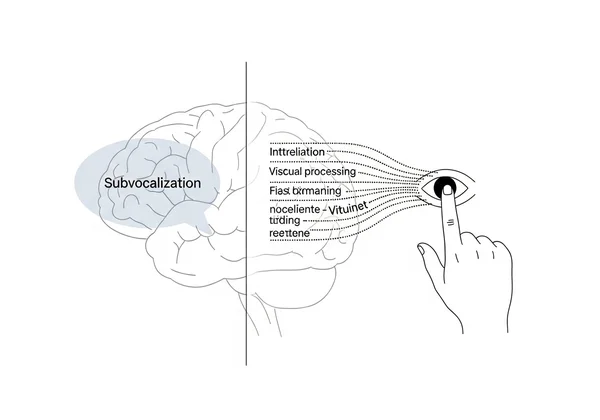
Expanding Your Visual Span: Reading More Words Per Glance
Instead of reading word-by-word, train your eyes to take in blocks of three to five words at a glance. This technique, known as chunking, dramatically reduces the number of eye movements (saccades) required to read a line, saving precious time. You can practice this by drawing light pencil lines to divide a sentence into several phrases and focusing on reading phrase-by-phrase. Over time, you will naturally start seeing and processing words in groups, significantly expanding your visual span and overall reading pace.
Mastering Active Reading for Deeper Comprehension and Recall
Speed is useless without understanding. Mastering active reading means engaging with the text instead of passively absorbing it. Before reading a passage, quickly scan the title and first sentence of each paragraph to get the main idea. As you read, mentally ask questions: What is the author's main point? What evidence is used to support it? What is the structure of the argument? Underlining key transition words and main ideas can also help. This proactive approach keeps your mind focused and improves both comprehension and retention, which is critical for answering questions accurately. You can test your skills on our platform.
Tailored Reading Strategies for SAT, GRE, and LSAT Sections
While core speed-reading techniques are universally beneficial, each standardized test has unique formats and demands. Applying tailored strategies will give you a competitive edge. Understanding the specific challenges of each exam allows you to refine your approach for maximum efficiency.
SAT Reading: Navigating Diverse Passage Types Efficiently
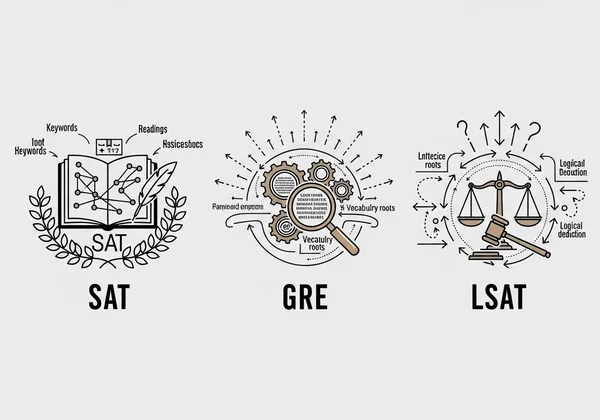
The SAT Reading Test features a variety of passage types, including U.S. and world literature, history/social studies, and science. Effective SAT reading tips focus on adaptability. For literature passages, pay close attention to tone, character, and theme. For history and science passages, focus on identifying the main argument, evidence, and data interpretation. Practice identifying the question type—whether it asks for a specific detail, an inference, or the main idea—and adapt your reading strategy accordingly. This targeted approach helps you navigate the diverse content efficiently.
GRE Verbal: Conquering Dense Academic Texts and Critical Reasoning
The GRE Verbal Reasoning section is known for its challenging vocabulary and dense, academic passages. Successful GRE verbal strategies involve more than just speed; they require sharp critical reasoning. Focus on understanding the logical structure of each passage. Identify the author's assumptions, evidence, and conclusion. Since many questions involve selecting the sentence that best fits a blank or analyzing an argument, your ability to quickly deconstruct complex sentences and understand their logical function is paramount. A great way to prepare is to regularly check your speed with similar texts.
LSAT Reading Comprehension: Deconstructing Complex Legal Arguments
The LSAT Reading Comprehension section is arguably the most challenging of all. Passages are often incredibly dense, with convoluted legal and philosophical arguments. To improve reading speed LSAT performance, you must become an expert at structural analysis. Focus on mapping the argument: identify the main conclusion, the premises that support it, and any counterarguments presented. Don't get bogged down in technical jargon. Instead, concentrate on the logical relationships between different parts of the text. This high-level, structural reading is key to untangling the complex arguments and answering questions accurately under intense time pressure.
Consistent Practice: Your Key to Sustained Improvement
Learning these strategies is the first step, but true mastery comes from consistent, deliberate practice. Building your reading speed and comprehension is like training for a marathon; it requires dedication and the right tools to measure your progress and stay motivated.
Integrating Daily Drills and Realistic Mock Tests
Set aside 20-30 minutes each day for focused reading drills. Use practice materials that mirror the difficulty and style of your target exam. Start by applying one technique at a time, such as using a pacer, until it becomes second nature. As you become more comfortable, integrate these skills into full, timed practice sections and realistic mock tests. This will not only improve your reading speed but also build the mental stamina needed to maintain focus throughout the entire exam.
Using Online Reading Speed Tests to Track Progress
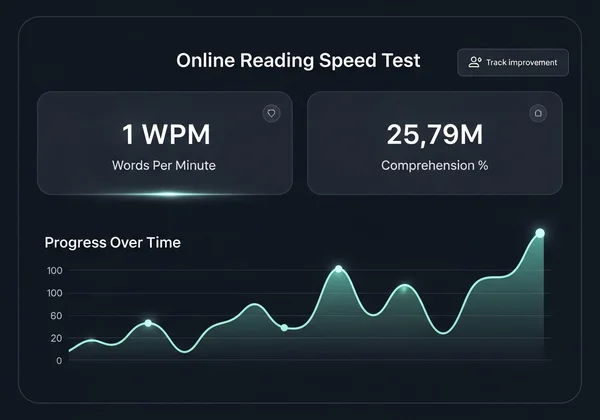
How do you know if your practice is effective? Objective measurement is key. By regularly using online reading speed tests, you can get precise data on your words-per-minute (WPM) and comprehension rate. This feedback loop is invaluable. It allows you to see tangible improvement, identify areas where you are still struggling, and adjust your training plan accordingly. A reliable tool can show you how your speed and accuracy stack up against benchmarks, providing the motivation to keep pushing forward. Ready to see where you stand? You can track your progress right now.
Your Path to Higher Scores: Become a Faster, Smarter Test Taker
Improving your reading speed for the SAT, GRE, or LSAT is one of the most powerful ways to boost your overall score. By understanding the demands of each exam, mastering core strategies like eliminating subvocalization and active reading, and committing to consistent practice, you can transform reading from a source of anxiety into a strategic advantage. Remember, the goal is not just to read faster, but to read smarter.
Ready to transform your test scores? It's time to put these techniques into action. The first step on your journey to a higher score is to establish a baseline. Visit ReadingSpeedTest.net to take our free, scientific reading speed and comprehension test. Discover your current WPM, assess your understanding, and start tracking your improvement today!
Frequently Asked Questions About Boosting Test Reading Speed
What is a good reading speed for standardized tests like the SAT or GRE?
For high-stakes exams, a competitive reading speed is generally between 300 and 450 WPM, coupled with a comprehension rate of 80% or higher. However, the ideal pace varies by test; the LSAT, for instance, often requires more deliberate, analytical reading. The key is to find the fastest speed at which you can maintain strong accuracy.
How can I improve my reading comprehension while reading faster for exams?
Improving comprehension while increasing speed involves active reading. Before you read, skim the passage for structure. As you read, constantly ask yourself about the main idea and the author's purpose. After reading, take a moment to summarize the key points in your own words. You can verify your skills with a reading comprehension test that provides immediate feedback.
Does reading on a screen affect my speed and focus during digital standardized tests?
Yes, reading on a screen can be more fatiguing for the eyes and may slightly reduce reading speed for those not accustomed to it. Since most standardized tests are now digital, it is crucial to practice on a screen. Adjust brightness, use tools to minimize distractions, and take short eye breaks during practice sessions to build your digital reading stamina.
How can I reduce subvocalization when practicing for timed reading sections?
To reduce subvocalization, actively engage other parts of your brain. Use your finger or a cursor as a pacer, moving it faster than your inner voice can keep up. You can also try humming softly or chewing gum while you practice, as these physical actions interfere with the mental process of "saying" the words in your head.